
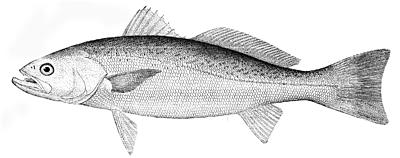
Taxonomy
- Kingdom
- Animalia
- Phylum
- Chordata
- Class
- Actinopterygii
- Order
- Perciformes
- Family
- Sciaenidae
- Genus
- Cynoscion
- Species
- acoupa
Habitat
Acoupa weakfish primarily inhabit coastal waters, estuaries, and bays in the western Atlantic from Argentina to the Caribbean. They prefer sandy or muddy bottoms in shallow to moderately deep waters, often tolerating a range of salinities from fully marine to brackish environments. These areas provide ample food and shelter near shorelines.
Diet
Acoupa weakfish primarily eat small fish, shrimp, crabs, and other crustaceans. They are ambush predators that hunt in schools, often striking at dawn or dusk when prey is most active. Feeding involves quick pursuits and swallowing prey whole in open water or near the seafloor.
Behavior
Acoupa weakfish are schooling fish that form large groups for protection and feeding, making them highly social in open waters. They are most active during twilight hours and exhibit seasonal migrations to follow food sources or warmer waters. These fish can be territorial around spawning sites but generally avoid aggressive interactions.
Fishing
Anglers targeting the Acoupa weakfish, a prized sport fish in the western Atlantic from Argentina to the Caribbean, should focus on trolling with diving plugs or spoons, or casting jigs and live baits to mimic their prey like small fish, shrimp, and crabs, as these ambush predators strike aggressively in schools; use medium-heavy rods with 20-30 pound test line, sturdy reels, and circle hooks to handle fish up to 42 pounds while promoting ethical catch-and-release. Opt for live shrimp, cut bait, or metal jigs as top lures, deployed near sandy or muddy bottoms in estuaries, bays, and coastal waters up to moderate depths, where these fish tolerate brackish conditions for ample feeding opportunities. The best season is spring to summer during warmer months when they spawn and are most active, with prime times at dawn or dusk for higher bite rates; target areas like Brazil, Guyana, or Trinidad and Tobago for consistent action, supported by angler-funded programs that bolster habitat restoration and maintain stable populations through regulated fishing. The IGFA all-tackle world record stands at 42 pounds 0 ounces, caught in 1996 off Brazil, highlighting the thrill of this species while conservation efforts, such as catch-and-release in certain zones, ensure their Least Concern status by the IUCN, with slot limits in some regions serving as effective tools to sustain healthy stocks and protect vital waterways.
Conservation Status
Listed as Least Concern by IUCN.